


What Is a Condensing Unit?
Release time: 2026-03-06
Definition of a Condensing Unit
A condensing unit is a pre-assembled refrigeration system component that combines several key elements responsible for compressing refrigerant vapor and rejecting heat to the surrounding environment.
In simple terms, the condensing unit performs two main functions:
1. Compress the refrigerant vapor coming from the evaporator.
2. Condense the refrigerant into liquid form by releasing heat through the condenser.
This process is a fundamental stage of the refrigeration cycle.
Condensing Unit Components
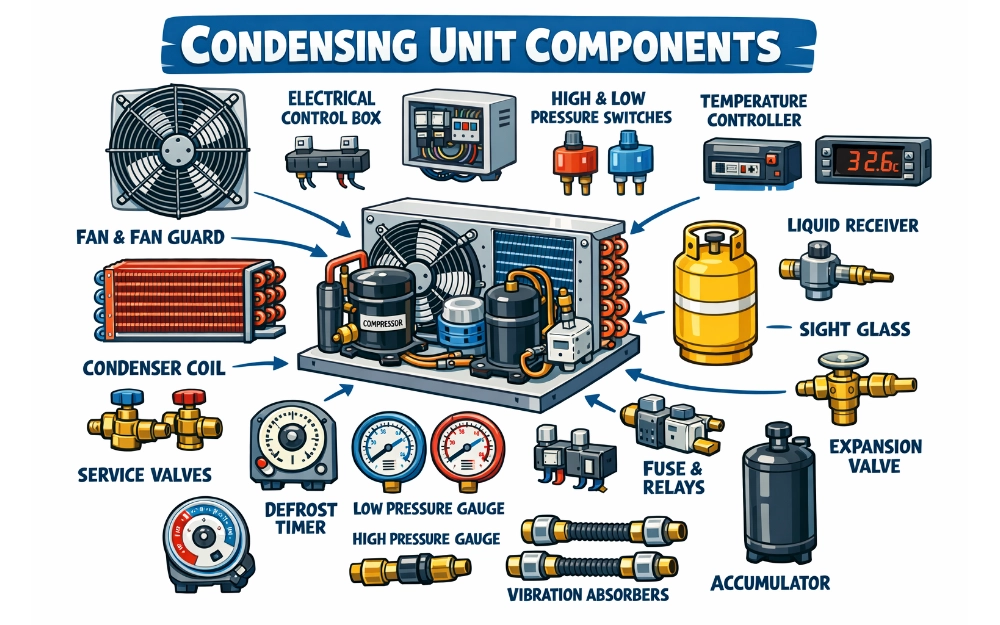
To gain a better understanding of a condensing unit, it is helpful to know its main components. Note that the specific parts may vary depending on the type of unit.
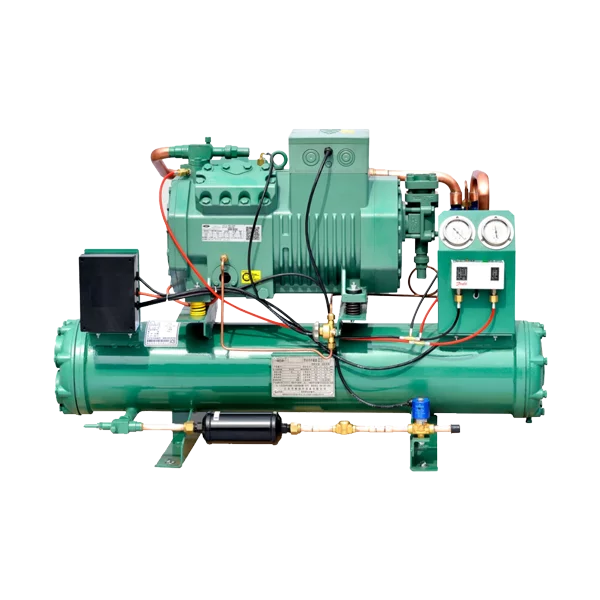
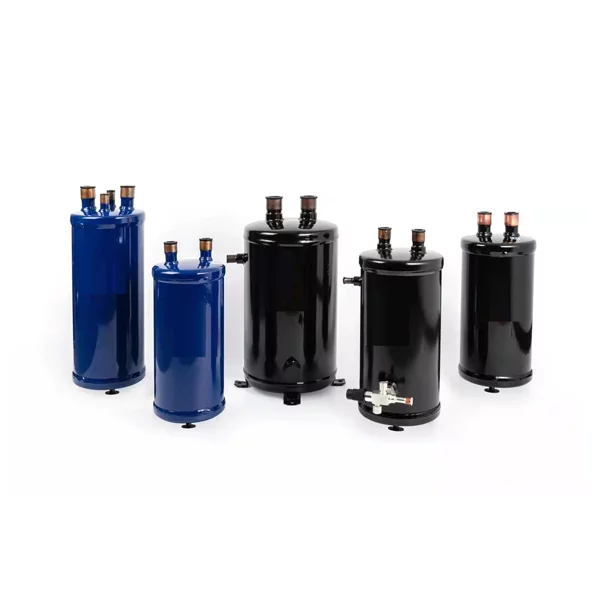
For a common air-cooled open-type condensing unit, the main components typically include the refrigeration compressor, condenser, fan motor, receiver, high- and low-pressure switches, accumulator, and mounting plate.
How a Condensing Unit Works
The condensing unit operates as part of the refrigeration cycle, working together with the evaporator and expansion device.
Step-by-Step Process
1. Evaporation
Low-pressure refrigerant absorbs heat in the evaporator and becomes vapor.
2. Compression
The compressor draws in this vapor and compresses it into a high-pressure, high-temperature gas.
3. Condensation
The hot gas flows into the condenser, where heat is rejected to the environment. The refrigerant condenses into a high-pressure liquid.
4. Expansion
The liquid refrigerant passes through an expansion device (TXV or capillary tube), reducing pressure and temperature.
5. Cooling Cycle Repeats
The refrigerant returns to the evaporator to absorb heat again.
This continuous cycle enables refrigeration systems to maintain controlled temperatures.
Types of Condensing Units
Condensing units are available in several configurations depending on the application.
Air-Cooled Condensing Units
Characteristics:
*Use ambient air for heat rejection
*Easy installation
*Lower initial cost
*Widely used in cold rooms and commercial refrigeration
Water-Cooled Condensing Units
Characteristics:
*Use water for heat rejection
*Higher heat transfer efficiency
*More stable performance in hot climates
However, they require:
*Cooling towers
*Water treatment systems
*Additional infrastructure
Evaporative Condensing Units
These combine features of both air and water cooling.
Advantages:
*Higher efficiency than air-cooled systems
*Lower water consumption than traditional water-cooled systems
Often used in large industrial refrigeration systems
Key Factors When Selecting a Condensing Unit
Choosing the correct condensing unit requires consideration of several parameters:
Cooling Capacity
Measured in:
*kW
*Tons of refrigeration (TR)
Capacity depends on:
*Room size
*Product load
*Ambient temperature
*Evaporating temperature
Refrigerant Type
Common refrigerants include
*R404A
*R507A
*R134A
*R449A
*CO₂ (R744)