


What is a Monoblock Refrigeration Unit?
Release time: 2026-03-13
A Complete Guide to Compact Cold Room Refrigeration Systems
In the refrigeration industry, monoblock refrigeration units have become an increasingly popular solution for small and medium-sized cold rooms. Their compact design, simple installation, and reliable performance make them widely used in supermarkets, restaurants, food processing facilities, pharmaceutical storage, and logistics cold chains.
This article explains what a monoblock refrigeration unit is, how it works, its components, advantages, and typical applications.
1.What is a Monoblock Refrigeration Unit?
A monoblock refrigeration unit is a compact, all-in-one refrigeration system designed for cold rooms. Unlike traditional split systems, the monoblock integrates all major refrigeration components into a single compact housing that is mounted directly onto the cold room wall or ceiling.
The unit typically contains:
*Compressor
*Condenser
*Evaporator
*Expansion device
*Electrical control system
Because all components are integrated into one module, installation is extremely simple and fast. The unit only needs to be mounted on the cold room panel and connected to power.
Monoblock systems are commonly used for small and medium-sized cold rooms, typically ranging from 5 m³ to 80 m³ depending on capacity.
2.How a Monoblock Refrigeration Unit Works
The working principle of a monoblock unit follows the standard vapor compression refrigeration cycle.
Step-by-step refrigeration process:
- Compression
The compressor compresses low-pressure refrigerant gas from the evaporator into high-pressure, high-temperature gas. - Condensation
The hot refrigerant flows into the condenser where heat is released to the surrounding air.
The refrigerant then condenses into a high-pressure liquid. - Expansion
The liquid refrigerant passes through the expansion device (capillary tube or expansion valve), reducing its pressure and temperature. - Evaporation
The low-pressure refrigerant enters the evaporator inside the cold room.
Here it absorbs heat from the room air, causing the refrigerant to evaporate back into gas.
This cycle continuously removes heat from the cold room, maintaining the required temperature.
3.Types of Monoblock Refrigeration Units
Monoblock units are usually classified based on installation method.
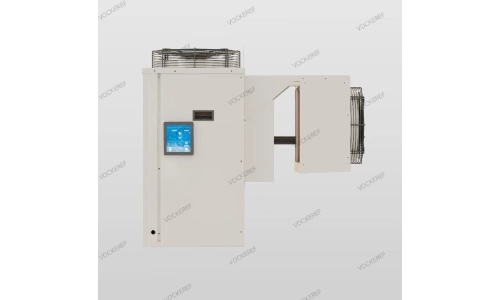
- Wall-Mounted Monoblock
Installed through the cold room wall panel.
Advantages:
*Easy installation
*Space-saving
Suitable for most small cold rooms
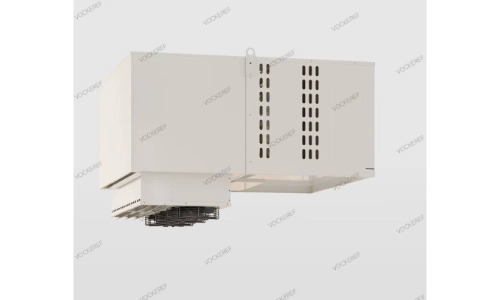
- Ceiling-Mounted Monoblock
Installed on the ceiling panel of the cold room.
Advantages:
*Saves wall space
*Ideal for narrow rooms
Better air circulation in some layouts
4.Temperature Ranges
Monoblock units are available for different temperature applications.
Medium Temperature (MT)
Typical temperature range:
-5°C to +10°C
Applications:
*Fresh food storage
*Beverage cooling
*Supermarket cold rooms
*Restaurant storage
Low Temperature (LT)
Typical temperature range:
-18°C to -25°C
Applications:
*Frozen food storage
*Ice cream storage
*Meat and seafood freezing
Low temperature units usually include electric defrost heaters to prevent ice buildup.
5.Advantages of Monoblock Refrigeration Units
Monoblock systems offer several advantages compared to traditional split refrigeration systems.
- Easy Installation
The unit is pre-assembled and factory-tested.
Installation typically requires only:
Mounting the unit to the panel
Connecting electrical power
No complex refrigerant piping is needed. - Lower Installation Cost
Since refrigeration piping and field assembly are minimal, labor costs are significantly reduced. - Compact Design
All components are integrated into a single compact housing, saving installation space. - Factory-Tested Reliability
Monoblock units are fully assembled and tested at the factory, ensuring consistent quality and reliable performance. - Ideal for Small Cold Rooms
For small cold storage facilities, monoblock systems are often the most economical and practical solution.
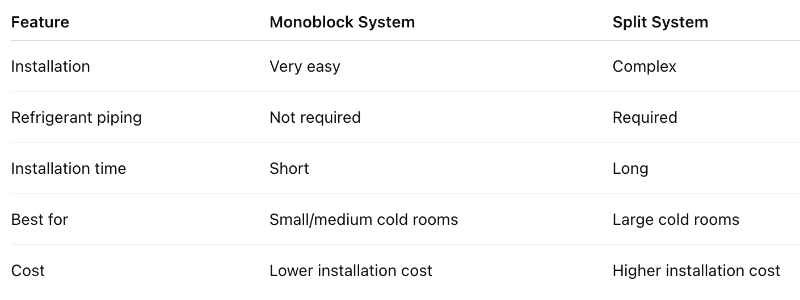
6.Monoblock vs Split Refrigeration Systems
7.Key Factors When Selecting a Monoblock Unit
When choosing a monoblock refrigeration unit, several factors must be considered:
*Cold room size (m³)
*Required temperature
*Ambient temperature
*Product type
*Insulation thickness
*Door opening frequency
Proper selection ensures efficient cooling and stable operation.
8.Future Trends in Monoblock Refrigeration
With increasing focus on energy efficiency and environmental protection, modern monoblock units are evolving toward:
*Eco-friendly refrigerants such as R290 and R449A
*Higher energy efficiency compressors
*Smart digital controllers
*Lower noise operation
These improvements help reduce energy consumption and environmental impact.
✅ Conclusion
Monoblock refrigeration units offer a simple, reliable, and cost-effective solution for cold room refrigeration. Their compact design, easy installation, and stable performance make them an excellent choice for small and medium cold storage applications across the food, pharmaceutical, and logistics industries.
As refrigeration technology continues to evolve, monoblock systems will remain an important solution for efficient and flexible cold storage refrigeration.