


The Science of Staying Cool: A Deep Dive into Cold Room Panels
Release time: 2026-04-07
Imagine walking into a warehouse the size of a football field. On one side, the outside temperature is a sweltering 35°C (95°F). On the other side, behind a seemingly thin metal wall, it is a steady -25°C (-13°F). What keeps these two worlds apart? The unsung hero of the cold chain: The Cold Room Panel.
Cold room panels, also known as insulated sandwich panels, are the building blocks of modern temperature-controlled environments. From your local butcher’s walk-in freezer to massive pharmaceutical distribution centers, these panels are the silent guardians protecting perishable goods.
Let’s strip back the metal and look at the science, structure, and secrets of these essential components.
Part 1: The Anatomy of a Panel (The “Sandwich” Principle)
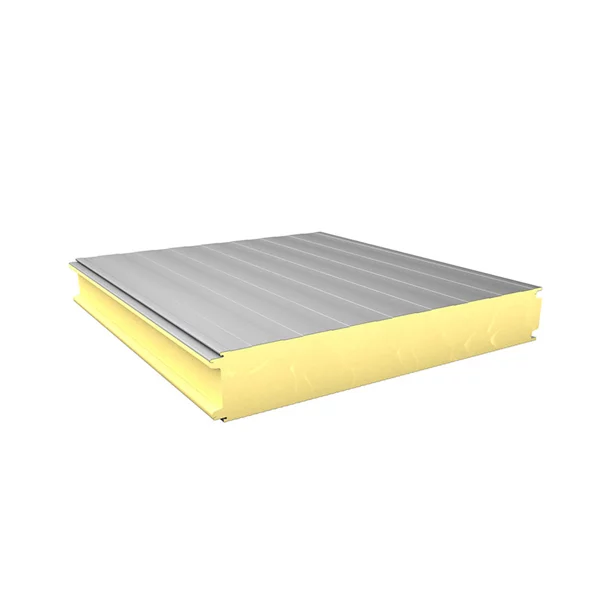
A cold room panel is not just a solid slab of material. It is a composite structure built on a simple but brilliant engineering principle: the sandwich.
It consists of three distinct layers:
1. The Outer Skins (The Bread): Typically made of pre-painted galvanized steel (PPGI), stainless steel, or aluminum. These skins provide structural rigidity, impact resistance, and a hygienic, easy-to-clean surface.
2. The Core (The Filling): This is the magic layer. The core is an insulating material that traps air (a poor conductor of heat) to stop thermal transfer.
3. The Bonding Agent (The Glue): High-pressure polyurethane adhesive is used to bond the skins to the core, creating a single, inseparable unit.
Part 2: The Core of the Matter – Types of Insulation
Not all cold room panels are created equal. The “filling” determines the panel’s efficiency, cost, and application. There are three primary types of cores used in the industry.
- Polyurethane (PU) – The Gold Standard
·What it is: A polymer formed by reacting a polyol and an isocyanate.
·R-Value (Thermal Resistance): Highest on the market (~R-7 to R-8 per inch).
·Science: PU is a closed-cell foam. The cells trap inert gas (usually a hydrocarbon like cyclopentane), which has very low thermal conductivity.
·Pros: Best insulation per thickness; lightweight; excellent structural strength.
·Use Case: Deep freezers (-40°C), pharmaceutical storage, and energy-efficient commercial coolers.
- Polyisocyanurate (PIR) – The Fire Fighter
·What it is: A modified version of PU with a higher isocyanate index.
·R-Value: Very high (R-6 to R-7 per inch).
·Science: PIR chars when exposed to fire. Instead of dripping burning plastic, it forms a protective carbon layer that blocks oxygen.
·Pros: Superior fire resistance; low smoke emission; dimensionally stable.
·Use Case: Buildings requiring strict fire codes (hospitals, high-rises, food processing plants).
- Expanded Polystyrene (EPS) – The Budget Choice
·What it is: The white, bead-like foam found in coffee cups and packaging.
·R-Value: Low to moderate (R-3.6 to R-4 per inch).
·Science: EPS is 98% air trapped in thin polystyrene walls. It does not contain blowing agents; it uses steam to expand beads.
·Pros: Cheapest option; chemically inert; recyclable.
·Cons: Absorbs water over time; lower structural strength.
·Use Case: Cool rooms (not freezers) like fruit ripening rooms or temporary structures.

Part 3: The Physics of Keeping Cold In
Why do these panels work? It comes down to Thermodynamics. Heat naturally flows from hot to cold. The job of a cold room panel is to slow this flow down to nearly zero.
There are three ways heat moves:
·Conduction (Direct contact): Heat traveling through a solid wall. The foam core stops this.
·Convection (Air movement): Warm air leaking through gaps. Panel tongue-and-groove joints stop this.
·Radiation (Infrared waves): Heat radiating from lights or walls. The reflective metal skin bounces this back.
The “Thermal Break”
The metal skin is conductive, so heat can travel around the foam via the edges. To prevent this, modern panels use a thermal break – a plastic separator between the inner and outer metal skins at the joint. This forces heat to take a longer, harder path to get inside.
Part 4: Assembly – The Puzzle of Perfection
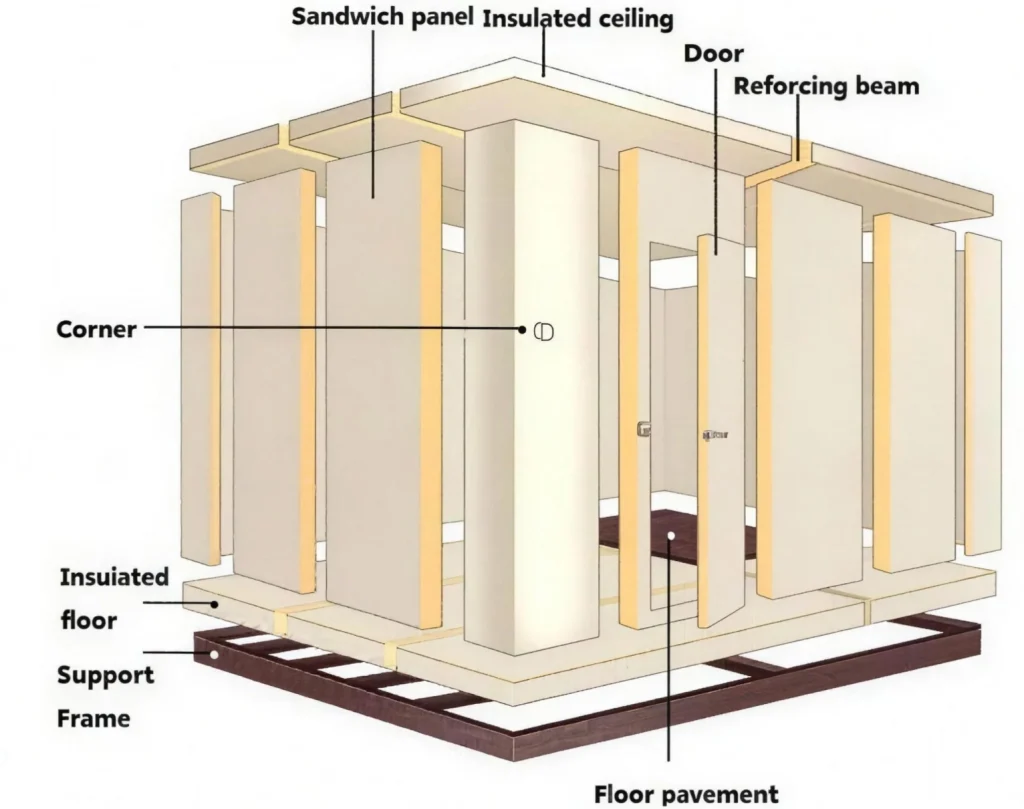
You don’t weld cold room panels. You click them together like a giant 3D puzzle.
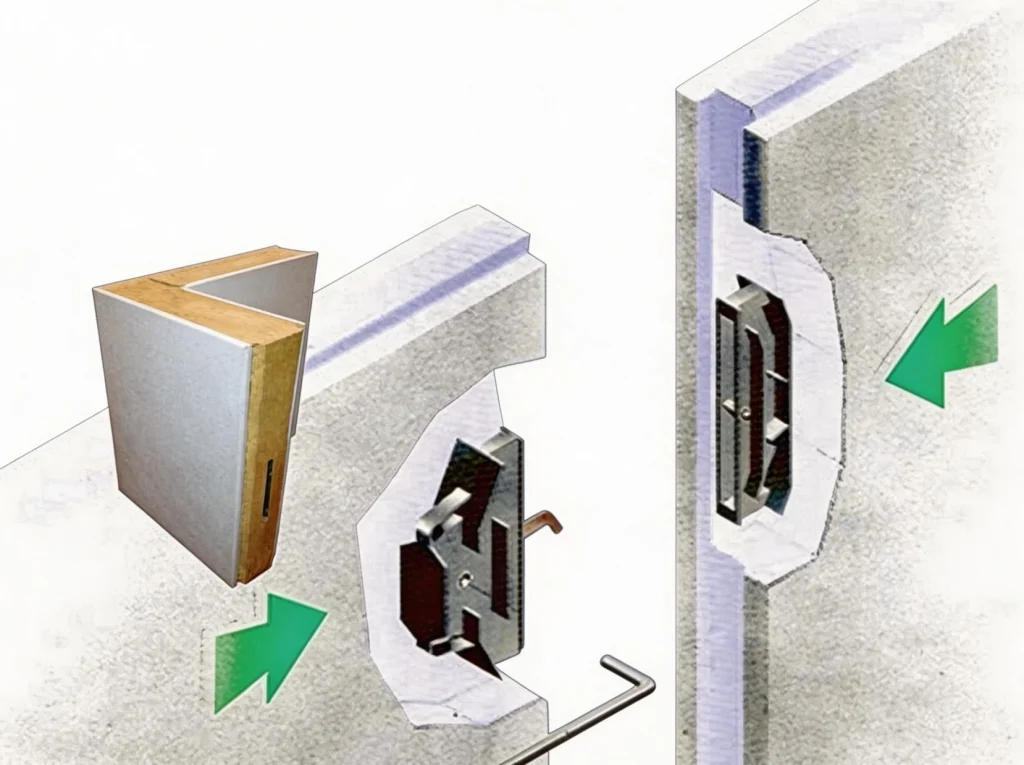
·The Cam Lock System: Most modern panels use rotating “cam locks” embedded inside the edge. You insert a special key (Allen wrench) into the panel edge and turn it 90 degrees. This pulls two panels tightly together with tons of force.
·Tongue and Groove: One panel has a protruding ridge (tongue) that fits into a matching channel (groove) of the next panel. A rubber or foam gasket sits in the groove to create an airtight seal.
·Sealants: Even with cam locks, installers run a bead of cold-room-grade silicone (which remains flexible at -30°C) along every joint.
The “Vapor Barrier” Rule
The warm outside air contains water vapor. If this vapor reaches the cold inner wall, it condenses and freezes into ice, destroying the insulation. The metal skin of the panel acts as a vapor barrier. If you puncture it, moisture will creep in. This is why damaged panels must be replaced immediately.
Part 5: Where You Find Them (The Cold Chain)
Cold room panels are the backbone of the global food supply and modern medicine.
- Food Processing: From slaughterhouses to chocolate factories. (Panels here often have curved corners to prevent bacterial growth).
- Pharma & Biotech: Storing vaccines (mRNA vaccines require -70°C), insulin, and blood plasma. These rooms often have redundant paneling and backup cooling.
- Logistics Hubs: Giant distribution centers where Amazon Fresh or Walmart store produce before delivery.
- Blast Freezers: Specialized rooms that use thicker panels (200mm+) to freeze food quickly, preventing large ice crystals from forming in the food cells.
Part 6: Common Questions Answered
Q: Can I cut a cold room panel to size?
A: Yes, with a circular saw and a carbide blade. However, you must seal the cut edge immediately with edge-sealing tape and silicone, or the core will absorb moisture and rust the metal from the inside.
Q: Why is my cold room floor different?
A: Floor panels are reinforced with thicker steel (often checker-plated) and high-density insulation (800kg/m³) to withstand forklifts and heavy pallet loads.
Q: How do I clean them?
A: Do not use high-pressure washers directly at the joints. Use a soft brush and a mild, non-abrasive sanitizer. High pressure forces water past the gaskets.
Q: How long do they last?
A: With proper installation and no physical damage, high-quality PU panels last 30+ years. EPS panels last about 10-15 years before moisture degrades them.
Conclusion
The humble cold room panel is a masterpiece of applied physics. It is a battle against entropy, using closed-cell foams and metal skins to defy the second law of thermodynamics.
Next time you bite into a frozen strawberry in December or receive a vaccine in the mail, thank the sandwich—not the kind you eat, but the kind that keeps the world cold.